Difference between revisions of "Steady-state turbulence modeling by Bahram Haddadi"
Jump to navigation
Jump to search
Jozsef Nagy (talk | contribs) (Blanked the page) |
Jozsef Nagy (talk | contribs) |
||
| (8 intermediate revisions by the same user not shown) | |||
| Line 1: | Line 1: | ||
| + | [[category:turbulence]] | ||
| + | [[category:RAS]] | ||
| + | * '''contributor''': Christian Jordan, Michael Harasek, Clemens Gößnitzer, Jozsef Nagy, Vikram Natarajan, Sylvia Zibuschka, Yitong Chen | ||
| + | * '''contact''': <mail address='[email protected]' description='author'>click here for email address</mail> | ||
| + | * '''OpenFOAM version''': OpenFOAM v12 | ||
| + | * '''Published under''': CC BY-NC-SA license ([https://creativecommons.org/licenses creative commons licenses]) | ||
| + | * '''Editorial board''': Bahram Haddadi, Christian Jordan, Michael Harasek | ||
| + | =[https://www.fluiddynamics.at/downloads/openfoam-basic-training/_tutorials/Example_Seven.pdf Turbulence – Steady state]= | ||
| + | |||
| + | '''Explanation''': Use simpleFoam solver, run a steady state simulation with following turbulence models: kEpsilon (RAS), kOmega (RAS) and LRR (RAS). | ||
| + | |||
| + | [[File:tuvienna6.png|450px|right|]] | ||
| + | |||
| + | '''Objectives''': | ||
| + | |||
| + | * Understanding turbulence modeling | ||
| + | * Understanding steady state simulation | ||
| + | |||
| + | Download pdf [https://www.fluiddynamics.at/downloads/openfoam-basic-training/_tutorials/Example_Seven.pdf here]. | ||
| + | |||
| + | Picture: Bahram Haddadi, TU Wien | ||
Latest revision as of 10:48, 9 April 2025
- contributor: Christian Jordan, Michael Harasek, Clemens Gößnitzer, Jozsef Nagy, Vikram Natarajan, Sylvia Zibuschka, Yitong Chen
- contact: click here for email address
- OpenFOAM version: OpenFOAM v12
- Published under: CC BY-NC-SA license (creative commons licenses)
- Editorial board: Bahram Haddadi, Christian Jordan, Michael Harasek
Turbulence – Steady state
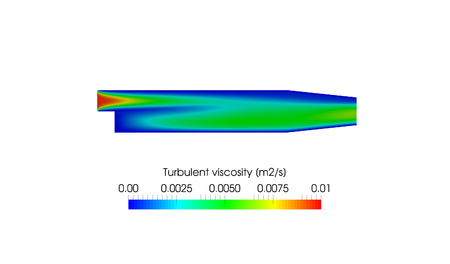
Explanation: Use simpleFoam solver, run a steady state simulation with following turbulence models: kEpsilon (RAS), kOmega (RAS) and LRR (RAS).

Objectives:
- Understanding turbulence modeling
- Understanding steady state simulation
Download pdf here.
Picture: Bahram Haddadi, TU Wien
