Difference between revisions of "T-junction by Bahram Haddadi and colleagues"
Jump to navigation
Jump to search
Jozsef Nagy (talk | contribs) |
Jozsef Nagy (talk | contribs) |
||
| Line 2: | Line 2: | ||
[[category:laminar]] | [[category:laminar]] | ||
* '''contributor''': Bahram Haddadi, Clemens Gößnitzer, Sylvia Zibuschka, Yitong Chen | * '''contributor''': Bahram Haddadi, Clemens Gößnitzer, Sylvia Zibuschka, Yitong Chen | ||
| − | |||
* '''contact''': <mail address='[email protected]' description='author'>click here for email address</mail> | * '''contact''': <mail address='[email protected]' description='author'>click here for email address</mail> | ||
* '''OpenFOAM version''': OpenFOAM v10 | * '''OpenFOAM version''': OpenFOAM v10 | ||
Revision as of 07:13, 9 April 2025
- contributor: Bahram Haddadi, Clemens Gößnitzer, Sylvia Zibuschka, Yitong Chen
- contact: click here for email address
- OpenFOAM version: OpenFOAM v10
- Published under: CC BY-NC-SA license (creative commons licenses)
- Editorial board: Bahram Haddadi, Christian Jordan, Michael Harasek
Residence time distribution
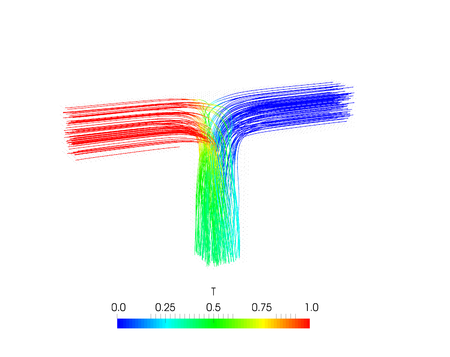
Explanation: Use simpleFoam and scalarTransportFoam to simulate the flow through a square cross section T pipe and calculate RTD (Residence Time Distribution) for both inlets using a step function injection.

Objectives:
- Understanding RTD calculation using OpenFOAM
- Using multiple solver for a simulation
Download pdf here.
Picture: Bahram Haddadi, TU Wien
